Designing Embodied Telepresence for Remote Collaboration: A Comparative Study of Robots and Avatars
April 22, 2026·,,,,,,,,·
0 min read
Hyunju Kim
Yeonju Jang
Mose Sakashita
Brandon Woodard
Yuki Suwabe
Danielle Ihechisim Imogu
Xiaozhen Liu
Guy Hoffman
François Guimbretière
Abstract
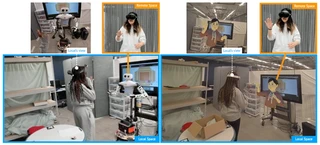
Telepresence systems enable remote collaboration through physical robots or virtual avatars, yet prior comparisons have focused on technical capabilities and affordances from remote users. This overlooks how local collaborators interpret and respond to embodied actions. We conducted a within-subjects study in which participants collaborated with a remote partner embodied as either a robot or avatar across various tasks. Both embodiments supported functionally equivalent actions: navigation, gesture, object referencing, and digital tool use. Despite this parity of system functions and tasks, participants consistently interpreted and organized collaboration differently: robots invited spatially grounded coordination and were framed as assistants requiring accommodation, while avatars invited engaged discussion and were framed as active collaborators capable of reciprocal interaction. We discuss design implications for aligning embodiment choices with the relational and task-specific demands of remote collaboration.
Publication
Proceedings of the ACM on Human-Computer Interaction (PACMHCI), CSCW 2026
CSCW-26
Authors
Authors
Authors
Authors
Authors
Authors
Authors
Authors
Authors